Micro-scale LNG, sized for the site.
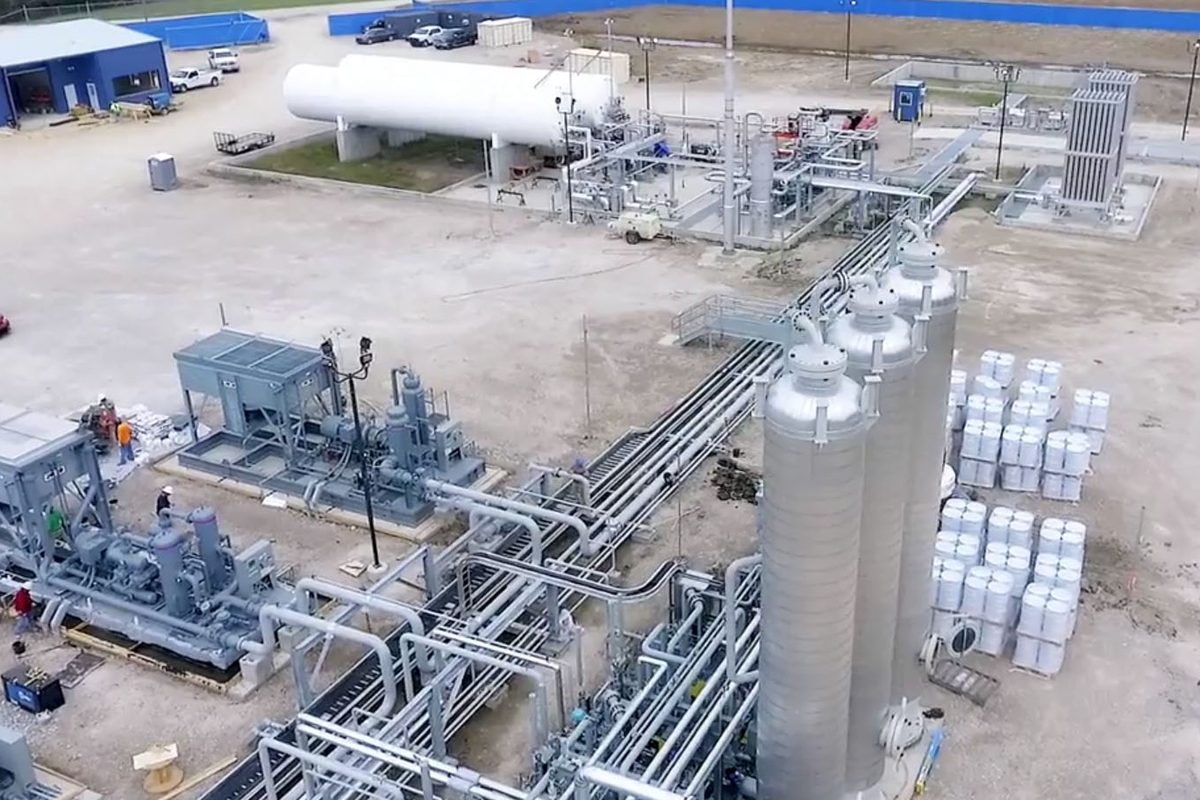
Three liquefaction platforms at about 19 to 25 tonnes per day per unit, chosen by feed pressure, power cost, capital and schedule. All ship as truckable skids, set on foundations, with first LNG in months rather than years. µSMR is offered through NuCryo, our joint venture with Crosstrails Engineering.
 By NuCryoA NuBlu Energy and Crosstrails Engineering joint venture
Overview
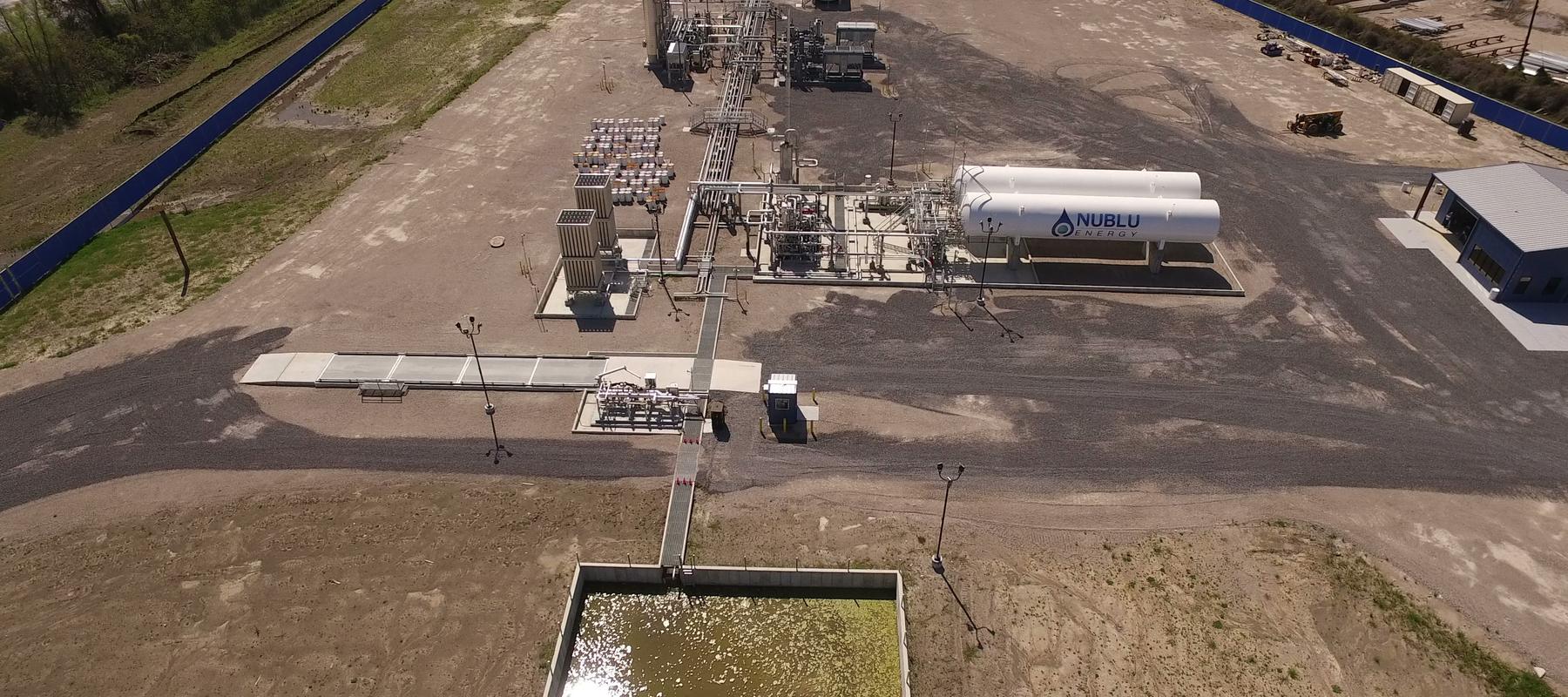
Gas that never reaches a pipeline is the market. A micro-scale plant produces roughly 25 tonnes of LNG per day, about 15,000 gallons, from pre-fabricated skids trucked to site. Capital is measured in millions rather than the billions of an export terminal, so a single gas source or a single offtaker can justify a plant, and the LNG leaves by truck or ISO container to data centers, mines, marine fleets, trucking fleets and industrial sites the grid skipped.
NuBlu has built and run micro-scale LNG before. The Port Allen, Louisiana facility has produced 30,000 GPD continuously since December 2017 and proved the feed gas refrigerant cycle, the modular pretreatment and the boil-off management that every NuBlu package now carries. What decides the technology for a new site is feed gas pressure, scale, capital, schedule and operating complexity. Each platform below wins on a different combination.
Key specifications
| mLNG | Feed gas refrigerant, turbo-expander cycle, brazed aluminum exchanger. 25 TPD pre-fabricated. Under 150 kWh per tonne with a 600 psig plus letdown, 600 to 800 kWh per tonne in closed-loop recycle. Lead time 12 to 15 months. NuBlu proprietary process, field proven since 2017. |
|---|---|
| µSMR | Single mixed refrigerant cycle (4 component), brazed aluminum cold box. About 25 TPD per unit, under 500 kWh per tonne (about 420 at 950 psig feed). Two-skid liquefaction system, lead time 10 to 12 months. Offered through NuCryo. |
| NuPresto LNG | Feed gas refrigerant with no expander, no brazed aluminum exchanger and no mixed refrigerant. Gas is compressed to 3,600 psig on two DA300 frames with independent motors, precooled by a standard propane chiller, cooled against its own flash vapor and boil-off in stainless steel exchangers, then let down to storage. About 19 TPD at roughly 800 kWh per tonne. Lowest capital of the three, lead time 6 to 8 months. |
| Feed gas | 300 psig minimum for NuPresto LNG; 700 to 950 psig for µSMR; 250 to 950 psig for mLNG, closed-loop recycle or pressure letdown |
| LNG product | -255 °F at about 14.5 psig (1 barg), denser than typical micro-LNG product, can be sub-cooled |
| Pretreatment | Inlet separation, amine, membrane or molecular sieve sweetening, water chilling and molecular sieve dehydration, mercury guard bed, optional UOP SepraSIV polishing for heavy hydrocarbons and BTEX |
| Inlet gas | Lean LNG-ready gas or rich field gas with entrained NGLs; optional full fractionation |
Performance figures are indicative for the 25 TPD class at stated feed conditions and are confirmed per site.
Capital and schedule: two components set the cost and the calendar
| Component | mLNG | µSMR | NuPresto LNG |
|---|---|---|---|
| Turbo expander (long lead, specialist vendor) | Yes | No | No |
| Brazed aluminum heat exchanger (long lead, few fabricators) | Yes | Yes | No |
| Mixed refrigerant system (inventory and composition control) | No | Yes | No |
| Stainless steel exchangers (conventional fabrication) | No | No | Yes |
| Propane precool chiller (standard commercial unit) | No | No | Yes |
| Relative capital cost | Highest | Mid | Lowest |
| Lead time to a liquefier on site | 12 to 15 months | 10 to 12 months | 6 to 8 months |
| Operating complexity | Expander machinery | Mixed refrigerant, most complex | Simplest |
Why LNG platforms
Pressure you already have is the cheapest refrigeration
Where a city gate or regulator station drops 600 psig or more, mLNG turns that free letdown into LNG at under 150 kWh per tonne. Where it does not, µSMR buys efficiency with a mixed refrigerant cycle at under 500 kWh per tonne, and NuPresto LNG accepts about 800 kWh per tonne in exchange for the lowest capital and the simplest cycle.
Two components set the cost and the calendar
The turbo expander and the brazed aluminum heat exchanger are the long-lead, high-cost items. mLNG carries both, µSMR carries the exchanger, NuPresto LNG carries neither, which is why it reaches site in 6 to 8 months, about half the time.
Hot ambient performance
The µSMR mixed refrigerant is optimized to minimize warm-end pinch at 100 °F ambient, so output holds up where competing micro liquefiers derate.
A colder, denser product
LNG leaves at -255 °F and about 1 barg rather than -220 °F at 60 psig, which improves density and storage efficiency and cuts boil-off.
Modular and truckable
µSMR ships as an MR compressor skid of about 13 ft by 30 ft and a liquefaction module of about 10 ft by 20 ft. NuPresto LNG uses stainless steel exchangers and a standard propane chiller, conventional fabrication available from multiple qualified shops.
Pretreatment engineered to the gas
Site-specific sweetening, dehydration and heavy hydrocarbon polishing rather than a standard go-by design, so the plant runs on the gas you actually have.
One team from FEED to first LNG
NuBlu's engineering group has executed LNG work from 14,000 GPD peak shavers to 500,000 GPD multi-train facilities, and built and operated its own plant.
Typical applications
- Data centers and behind-the-meter power where the grid cannot deliver on the developer's timeline
- Flare and stranded gas liquefied at the source
- Mining and remote industry displacing trucked diesel
- Fleet fueling for long-haul trucking, rail and drilling fleets
- Marine bunkering for harbor craft and short-sea fleets
- Pipeline letdown and utility peak shaving (mLNG)
- Merchant industrial LNG for off-grid plants and kitchens
- Telecom tower power where diesel is the incumbent
What's included
- Liquefier skids, pretreatment modules and interconnecting piping, engineered to the site gas
- LNG storage, pump and loadout design, including BOG recovery
- MCC, PLC and instrument air engineering, control room and utility equipment
- Start-up spares, first fills and commissioning support
- Initial operating support and optional service contract
NuPresto LNG: simplest cycle, shortest schedule
NuPresto LNG is the NuBlu cycle built from standard parts. Pipeline gas at 300 psig or more is compressed to 3,600 psig on two DA300 frames with independent motors, precooled by a standard propane chiller, cooled against its own flash vapor and boil-off in stainless steel exchangers, and let down through a JT valve into a flash drum and storage. Flash vapor and boil-off return through the exchangers to suction, and tail gas fuels the site.
- No turbo expander, no brazed aluminum exchanger, no mixed refrigerant inventory
- Stainless steel exchangers and a propane precool chiller from the standard HVAC supply chain, so several qualified shops can build it
- About 19 TPD at roughly 800 kWh per tonne, the lowest capital of the three platforms
- Lead time to a liquefier on site of 6 to 8 months, about half that of mLNG
- The lowest operating complexity: two compressor frames, a chiller and a letdown
Proven at Port Allen
The team validated its LNG technology at Port Allen, Louisiana: a 30,000 GPD (50 TPD) plant with 100,000 gallons of storage on an 11-acre site near the Mississippi River. Operational since December 2017, FTA export license received in June 2018, sold to Stabilis in 2021 after years of stable operation, and still running. The PHMSA and DOT construction audit was completed successfully, and the gas pretreatment unit was later upgraded to UOP SepraSIV molecular sieve technology to resolve benzene freeze-up. Read the Port Allen case study.
Engineering and aftermarket support
NuBlu and NuCryo deliver liquefaction as equipment supply, as a fuel supply partnership, or as energy as a service. Each engagement starts with the site: gas composition and pressure, offtake volume, power and an LNG loadout path.
For larger single-train plants and international project delivery through NuCryo, visit nucryo.com.
About NuCryo. NuCryo is a joint venture between NuBlu Energy and Crosstrails Engineering focused on micro and small-scale LNG liquefaction. The µSMR platform is designed, engineered and packaged jointly. Fabrication, assembly and factory testing run through NuBlu's facility in Center, Texas. Learn more at nucryo.com.